Group Exhibition — New Horizons IV
The Foundation is pleased to present the fourth edition of the New Horizons annual exhibition. It will take place from November 28 to December 20, 2026, in Saint-Edmond-de-Grantham. This edition will feature works by Camille Champagne (Université du Québec à Trois-Rivières), Marjorie Lavoie (Université du Québec à Chicoutimi), Gaëlle Legrand (Concordia University), Gabrielle Turbide (2026 Winner, Université du Québec à Montréal), Solenn O’Meara (Université Laval), and Jérémie Roussel (Université du Québec en Outaouais).
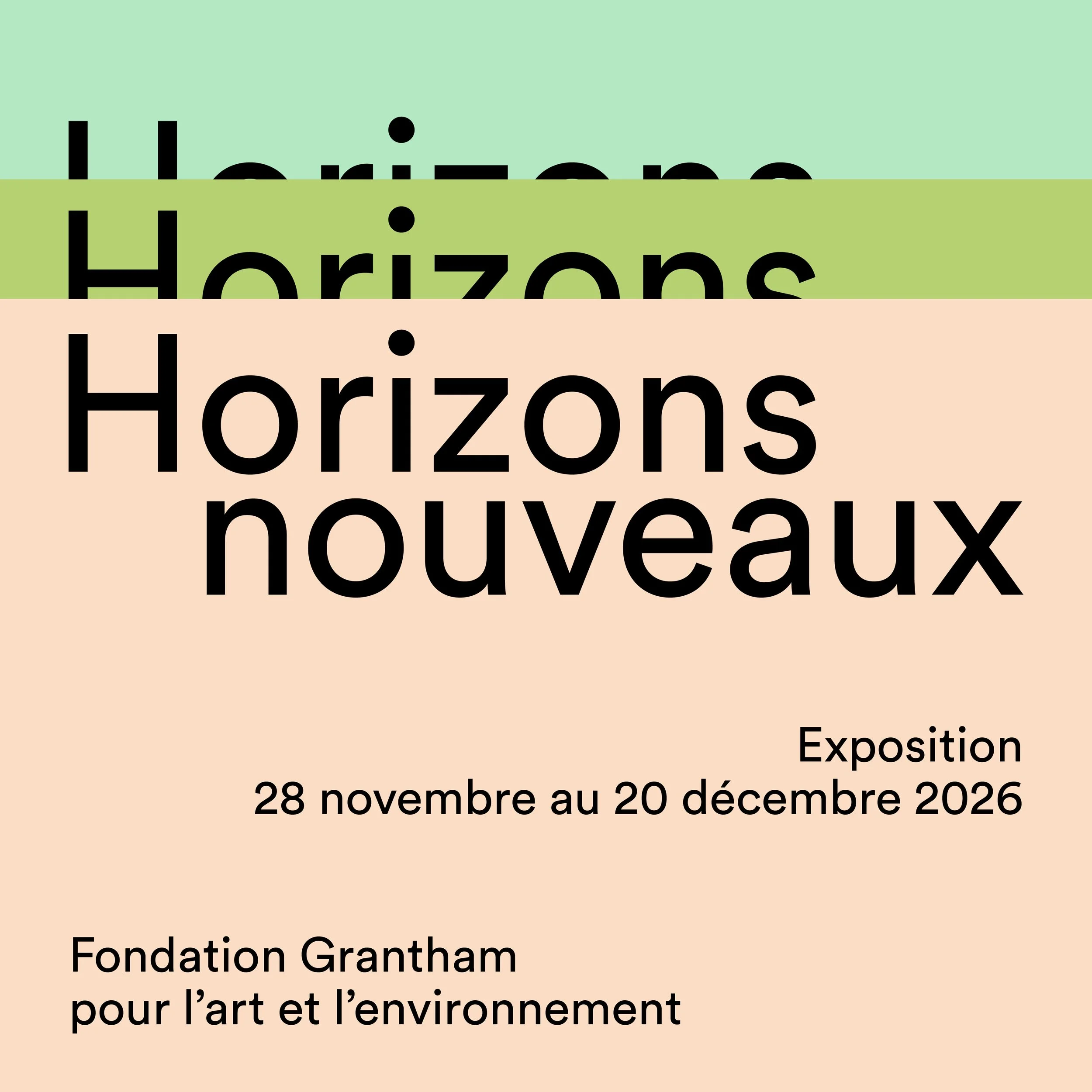
Graphic design: Victor Percoco
New Horizons IV
Text by Marianne Cloutier
Artistic Director, Grantham Foundation
Gabrielle Turbide, 2026 Winner
Based in Tiohtià:ke/Mooniyang/Montréal, Gabrielle Turbide is an interdisciplinary artist. Her practice lies at the intersection of art, biology, and technology. Through her exploration of DIY biotechnologies, biomaterials, and chlorophyll printing, she creates experimental ecosystems made with plants, microorganisms, and low-tech devices.
Her work seeks to make visible the dynamics of transformation, adaptation, and resistance inherent to living systems, giving rise to evocative forms that emerge from unstable, and only partially controllable, biological processes. These projects take the form of living archives and open laboratories, inviting critical inquiry into archiving, preserving, and image degradation processes.
For more information on her work, click here.
Camille Champagne
Based in Mauricie, Camille Champagne is a multidisciplinary artist who holds a bachelor’s degree in visual arts and is currently a master’s candidate at UQTR. Her practice, centered on photography, printmaking, and hybrid processes, explores the concept of the ruin as a space for reflection on the territories we inhabit. Through her work, she re-examines the imagery of ruins to question our relationship with space.
The fire that destroyed her family home in 2024 profoundly transformed her perception of this subject, lending an intimate dimension to the notions of loss, memory, and place. Blending traditional techniques with digital processes, Camille Champagne’s approach investigates the ecological and cultural transitions we are undergoing, while revealing the poetry that can be found in what remains after something has vanished.
Marjorie Lavoie
Based in Chicoutimi, Marjorie Lavoie is a visual artist, psychologist (D.Ps.), art therapist, and lecturer at UQAC. Her interdisciplinary background informs a research-creation practice rooted in the northern landscapes of the Saguenay–Lac-Saint-Jean region, exploring the connections between the body, the land, and the living world. Through installations, textile works, and site-specific interventions crafted from organic materials, her work offers sensory experiences that invite us to rethink how we inhabit our landscapes.
At the core of her approach are the concepts of "fjordicity" (fjordicité) and "athletic gliding" (glisse athlétique). Fjordicity offers a sensory interpretation of the territory, in which the fjord becomes a space for creation, memory, and connection. Athletic gliding frames bodily movement as an artistic gesture, as a way to engage in a dialogue with the landscape.
Gaëlle Legrand
Originally from France, Gaëlle Legrand is an artist who lives and works in Tiohtià:ke/Mooniyang/Montréal. She recently completed her BFA in Sculpture at Concordia University, where she also served as a visiting researcher at the Post Image Cluster, a centre for photographic research.
Guided by an exploration of the ontology of matter and forms within the plant world, Gaëlle Legrand examines how interconnection, reciprocity, and relationship manifest in living systems. She works with wood, metal, and image-based processes to create minimalist, organic installations, through which she explores the unfolding of lines in space, as well as concepts of spatial composition and perception. Drawing inspiration from the embodied knowledge of her ancestors, who were carpenters and farmers in northern France, her practice is rooted in a personal connection to materials, landscape, and lived experience.
Solenn O’Meara
Based in Quebec City, Solenn O’Meara holds a double bachelor’s degree (Visual and Media Arts and in Visual Arts Education) from Université Laval, where she is also currently pursuing a master’s degree in Visual Arts. Bridging research-creation and the transmission of knowledge, her practice is intrinsically linked to her way of life. She treats the everyday as a site for experimentation, revealing the interconnections between beings, places, and the traces we leave behind.
Employing a "documentary fiction" approach, Solenn O’Meara work focuses on ordinary gestures, routines, and relationships. Her projects often take the form of shared spaces that foster collective attention. Through installation, photography, video, sound, and artist books, she explores themes of care, friendship, and coexistence between humans and plants.
Jérémie Roussel
Based in Gatineau, Jérémie Roussel is an artist and researcher. While completing a master’s degree at the School of Arts and Cultures at UQO, he explores the epistemic gaps between art and science, engaged practice and theoretical systematization, critical transparency and discursive opacity, and between sensory reality and factual "truth."
Jérémie Roussel’s work specifically interrogates the convergences between the logics of professionalization and the mechanisms of techno-scientific indoctrination, mechanisms which are deeply rooted in an extractivist logic. Through an approach he describes as "[self-]alienation" tinted with irony, his work aims to deconstruct the ideological conventions by which class and power relations are institutionalized.